What Apparel Brands Get Wrong About Product Data
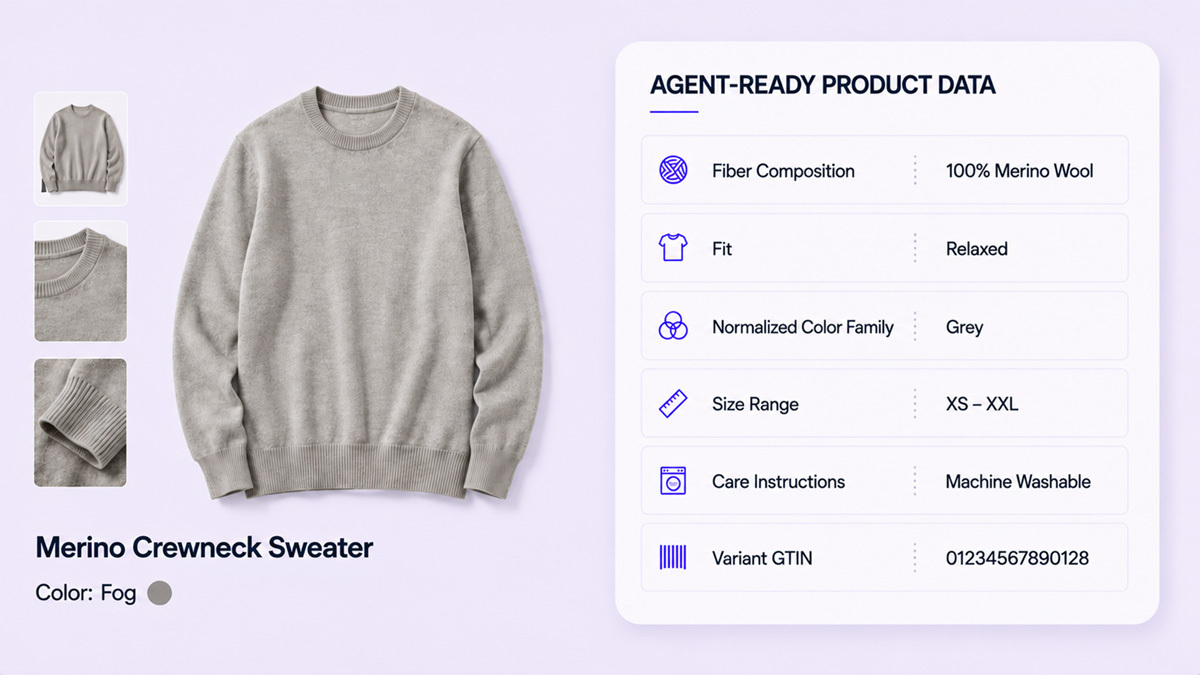
Apparel brands are not bad at content. They are the best in retail at it, and it is not close. The conversations I have with merchandising and eCommerce teams almost never start with a content problem, because the photography is beautiful, the copy has a voice, and the site converts. The gap is somewhere else. It is in the structured attributes underneath, the values a machine reads when it decides which sweater to put in front of a shopper.
That distinction did not matter much for years. A person browsing a category page forgives a missing field, because they can see the garment. They look at the photo, read two lines, and decide.
An agent cannot do that. When a shopper asks an AI tool for a machine washable merino crewneck in a relaxed fit under two hundred dollars, the tool does not look at the photography. It reads attributes and it compares them. A product whose fiber content lives in a paragraph, whose fit lives in a size chart image, and whose care instructions live in a symbol on a label, is a product that does not enter the comparison at all.
That is the shift, and it is the reason apparel product data is worth a hard look right now.
The attributes are the product
Nobody buys a garment because the description reads well. They buy it because it is the right fiber, the right weight for the season, the right fit through the shoulders, in a color they actually want, that survives a wash.
Those are the attributes: fiber composition with percentages, fabric weight, knit or woven construction, fit descriptor, rise and inseam on bottoms, band and cup on intimates, width on footwear, neckline, closure, care method, country of origin, season, and the sustainability credentials the brand has earned. In apparel, those values are not metadata about the product. They are the product, expressed in the only form a machine can read.
Most of them exist somewhere inside the business. That is the frustrating part. The tech pack knows the fiber content. The size chart knows the measurements. The care label knows the wash. None of it is sitting in the product record as a discrete, validated value, so none of it is available to an agent, a filter, or a natural language search.
A value trapped in a sentence is invisible. A value trapped in an image does not exist.
One style is not one product
A single style becomes dozens of records the moment it ships. Six sizes and four colorways is twenty-four variants, and each one needs its own identifier and its own set of values that are actually true of that variant.
This is where apparel data quietly breaks. Fiber content belongs to the style. Color belongs to the colorway. Measurements belong to the size. When those get set at the wrong level, the record contradicts itself, and the contradiction surfaces in the worst possible place, which is a comparison a shopper is running right now. A relaxed fit that is only relaxed in three of the six sizes is not a description problem. It is a level problem.
Identifiers compound it. Every sellable variant needs its own GTIN, and marketplaces and agents both resolve products on those identifiers. A style that shares one identifier across colorways collapses into a single ambiguous product, or duplicates, or gets rejected outright. Getting this right is unglamorous and completely mechanical, which is exactly why it should not be a person’s job. Identifier validation should run at a full pass rate with zero duplicates every time, because it either passes or it does not. There is no judgment involved.
Your color names do not filter
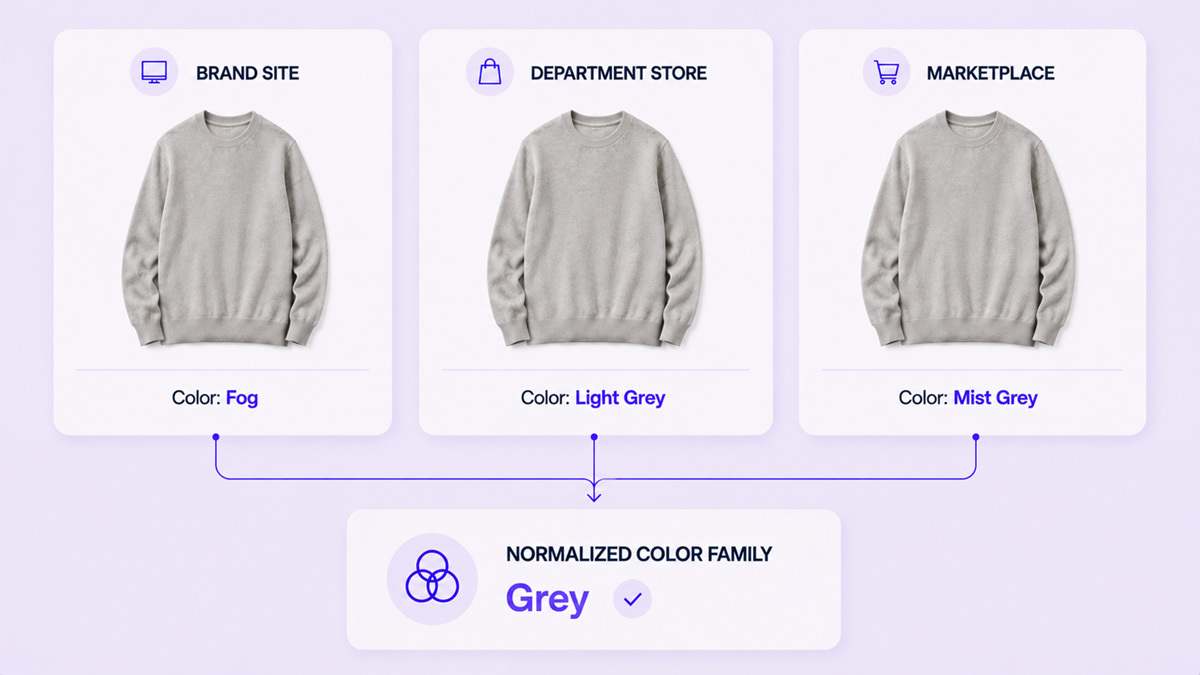
Brand color names are a genuine asset. Fog, Ash, Oatmeal, and Bone belong on the product page, because they carry the brand.
They also cannot be filtered, sorted, or compared. A shopper narrowing to grey, and an agent looking for grey, need a normalized color family sitting behind the brand name. Not instead of it. Behind it.
Your size chart is a picture
Sizing has the same shape as color and it is harder. Apparel runs alpha sizing, numeric sizing, EU and UK conversions, denim in waist and inseam, and footwear in three regional systems plus width.
A brand that carries all of that as display text has a beautiful size selector and nothing a machine can reason about. The measurements are rendered rather than stored, so nothing downstream can read them. Not a filter, not a search, not an agent comparing two garments on the only dimension that decides whether one of them fits.
This is the specific thing that costs apparel brands money without ever appearing in a report. Fit is why garments come back, and fit is the attribute most often missing in structured form. Nobody logs the shopper who filtered for a relaxed fit and never saw the product, and nobody logs the return that a stated inseam would have prevented.
Every season is a new catalog
An industrial distributor can plausibly talk about getting the catalog in order once. Apparel cannot. The catalog turns over on a schedule, several times a year, plus mid-season drops and collaborations that arrive faster than that.
So the work is never finished, and treating it as a project guarantees losing. A brand that gets its attributes right for spring inherits an entirely new assortment for fall, with new fabrics, new colorways, and new fits, at the moment the team is busiest. The only version of this that holds is a pipeline that runs on every new style as a matter of course, with the same rules applied every time.
That is a different thing to buy than a cleanup. It is also the only thing that survives contact with an apparel calendar.
Your brand is being read from someone else’s data
Here is the part that gets attention in the room. A brand does not control most of the places its products are described.
Wholesale accounts, department stores, marketplaces, and resellers all re-key product information into their own systems, with their own field names, their own truncation, and their own guesses about what the fabric is. Every one of those records is a version of the brand. As AI agents pull from whatever sources they can reach, the thinnest and least accurate version competes with the brand’s own. Sometimes it wins, because it happens to be more machine readable.
One authoritative, validated attribute set is the answer to that, and it is worth more to a premium brand than to anyone else, because a premium brand is exactly the one being misdescribed by a discount reseller. Agent-ready attributes are how a brand stays recognizable in a channel it does not own.
What good looks like
The fix is not another system of record. PIM platforms store and organize what a brand already has. They do not generate the attributes that are missing, and they do not validate values against the rules of the category the product belongs to.
That validation layer is what has to be automated, because the rules are category-specific and there are hundreds of them. A rule that is correct for outerwear is a defect applied to footwear. atronous maintains a constraint engine across more than 400 product categories, each carrying its own validation vocabulary, enforced independently, so apparel attributes never inherit logic written for something else. AI generates the content. Deterministic logic validates every value before anything is delivered. Nothing ships without passing.
In practice that means structured attributes generated at real depth, up to 63 per SKU in a single delivery run, with every product classified into the right category first. A recent enterprise run processed more than 50,000 records at a success rate above 98 percent, returned a full pass rate on identifier format and check digits with zero duplicates, and surfaced 18 distinct categories of data quality issues with the reasoning attached to each one. Records that cannot pass come back flagged and explained. Nothing is dropped in silence, and every rule change is logged by date, source, and reason.
The same validated attributes do a second job, which is the one most brands have not costed yet. They are the layer underneath a brand’s own natural language search, its recommendations, and any conversational agent it runs. A shopper asking whether a coat is warm enough for a Chicago February is asking about fill power, weight, and lining. That question is answerable only if those values exist as values. Measuring what is actually there, against what the category requires rather than against how many fields are populated, is where this starts.
See what agents see
The fastest way to know where a catalog stands is to have a sample of it measured and returned. Send up to 50 SKUs out of the PIM or ERP, exactly as they live in the system, and atronous runs them through the same pipeline enterprise customers rely on. Within five business days the sample comes back generated and validated, with the taxonomy and schema recommendations behind the work and a working session to walk through what was found.
No pitch. Real records, measured against the rules of their categories, so the gaps are visible instead of theoretical.
Request a Data Quality Assessment, or see how atronous handles apparel and fashion product data.
Intelligence in every attribute.
Frequently asked questions
What is apparel product data?
Apparel product data is the structured set of values that describe a garment or shoe precisely enough for a person or a system to decide whether it is right. It covers fiber composition and percentages, fabric weight and construction, fit descriptor, measurements such as rise and inseam, neckline and closure, normalized color family alongside the brand color name, the full size range in the systems the brand sells into, care method, country of origin, season, sustainability credentials, and a unique identifier for every sellable variant. In apparel the description sells the garment and the attributes decide whether it is ever seen.
Why do AI agents skip products that look fine on the site?
Because an agent does not look at the page. It reads structured attributes and compares them across products. When fiber content sits inside a paragraph, sizing sits inside a chart image, and care instructions sit on a label, there is nothing for the agent to compare, so the product is passed over rather than rejected. The listing looks healthy to a human reviewing it and is effectively absent from the comparison.
What is the difference between style-level and variant-level attributes?
Style-level attributes are true of every version of the garment, such as fiber composition and construction. Colorway-level attributes are true of one color, such as the brand color name and its normalized family. Size-level attributes are true of one size, such as measurements and the identifier. Setting a value at the wrong level is how a record ends up contradicting itself, and the contradiction shows up in a filtered search or an agent comparison rather than on the product page, which is why it goes unnoticed.
Does this replace a PIM?
No. A PIM is a system of record. It stores and organizes what a brand already has and requires manual configuration to do it. atronous generates the attributes that are missing, validates every value against the rules of its category, and delivers verified data into the PIM, the ERP, and the systems downstream of them.