AI Agents Shop on Attributes. The Depth and Accuracy of Your Product Data Decides What They Buy.

When half the web is machines, value moves to the door and the till. The decision in between is made on attributes, and that is the part you actually control.
A statistic crossed a line this month that should change how every commerce team thinks about its product data. Writing in Forbes, Grove Ventures partner Renana Ashkenazi marked the moment machines became the majority online. By the latest count, automated visitors are now 53 percent of web traffic. Most of that is the ordinary background noise of the web, scrapers and crawlers and fraud bots that have been around for years. One slice is not ordinary. Traffic from AI agents grew nearly 8,000 percent last year, and that is the slice that should hold the attention of anyone who sells a product online.
Her article is sharper than the headline suggests, and it is worth reading in full. The argument is not simply that advertising is in trouble. It is that the entire value map of the web is being redrawn. For thirty years the model was a bet on a human in a mood, browsing, catchable by the right ad at the right moment. An AI agent is not in a mood. It checks a dozen retailers before you open the second tab, ignores the banner, and as Ashkenazi puts it, it “reads the price and the specs, buys and leaves.” It was never going to click.
So she asks where the money goes once the ad slot stops working, and her answer is the most useful part of the piece. Value migrates to two places. It moves to the door, where companies like Cloudflare now charge AI crawlers for entry. And it moves to the till, where Mastercard and Visa have launched payment layers built for the tiny, high-frequency transactions that machines run. The most valuable real estate online, in her telling, stops being the billboard beside the content and becomes the toll gate in front of it.
She is right about all of it. There is one layer she does not address, and for anyone actually selling a product, it is the layer that decides who wins.
Between the door and the till, the agent chooses on attributes
The toll gets the agent in. The payment rail lets it pay. Neither of those decides what it buys. In between sits the moment Ashkenazi describes almost in passing, the moment the agent reads the price and the specs. That is a decision, and it is made on attributes.
Consider how an agent actually shops. A person types “65-inch TV” and scrolls through whatever appears. An agent resolves a precise instruction. Find a 65-inch OLED, under $800, with low input lag, available for delivery this week. It filters and ranks on every one of those attributes. Each attribute in the instruction is a gate. If your product is missing the input-lag value, you are not ranked lower. You are out of the set. The agent cannot choose what it cannot read.
This reframes an old idea for the new web. Product data was treated as a description, something to fill in well enough for a human to get the gist. For a machine, the data is not a description. It is the eligibility list. The number of decision-relevant, validated attributes you carry is the number of agent queries your product can ever enter. Thin data does not just describe your product poorly. It shrinks the set of machine decisions you are allowed to compete in. That is the growth bottleneck of the agent web, and most companies cannot see it, because their data was built for a reader who could fill the gaps in for themselves.

Depth is only half of it. The other half is proof.
More attributes win more queries only if the attributes are correct. An agent does not forgive a wrong value the way a person might. It computes on the bad value and moves on, and a confident error is worse than a blank, because it puts you in the wrong result set entirely. So the real requirement is two things at once. The data has to be deep enough to enter the comparison, and correct enough to survive it.
This is where most approaches break, because depth and correctness pull against each other. Generating more attributes is easy. Generating more attributes that are right, inside the rules of the specific category, is the hard part, and it is the part that actually decides outcomes at machine speed.
Why most product data is not ready
Most companies believe their product data problems are about content. Thin descriptions, inconsistent titles, messy variants. The real problem is structural, and machines reading at scale make it impossible to ignore.
Every product category carries its own rules. Allowable variant dimensions. Attribute vocabularies. Unit-of-measure conventions. Identifier logic. A rule that is correct for office furniture is a defect when applied to writing instruments. Across hundreds of categories, the complexity of those constraints grows past what humans and generic AI can manage by hand. Generating attributes is the easy part. Generating the right attributes, inside the right constraints, for the right category, with correctness you can prove, at scale, is the unsolved part. It is also the exact thing that decides whether an AI agent can act on your data or quietly passes it by.
A page that looks finished to a person can still fail a machine. The check-digit on an identifier is wrong. A decision-relevant attribute is absent. A value violates the category rule the agent relies on to compare. None of this shows up in a screenshot. All of it is decisive at machine speed.
What we are doing about it
At atronous, we built a product data intelligence engine for exactly this moment. The approach rests on a separation that matters more with every quarter the machine share of traffic grows. AI generates the wide range of attributes a product needs to be found and compared. Deterministic logic validates every record against category-specific rules before anything is delivered. The two systems are never conflated, because generating attributes and proving them are different jobs.
Underneath that sits a constraint engine spanning more than 400 product categories, each with its own validation vocabulary, enforced independently. Every record can pass through up to seven validation checks before delivery, covering format, check-digit, identifier cross-reference, uniqueness, and provenance. The result is not a thin file that reads cleanly, and not a fat file full of hidden errors. It is deep, verified, decision-ready product data that a machine can act on without guessing.
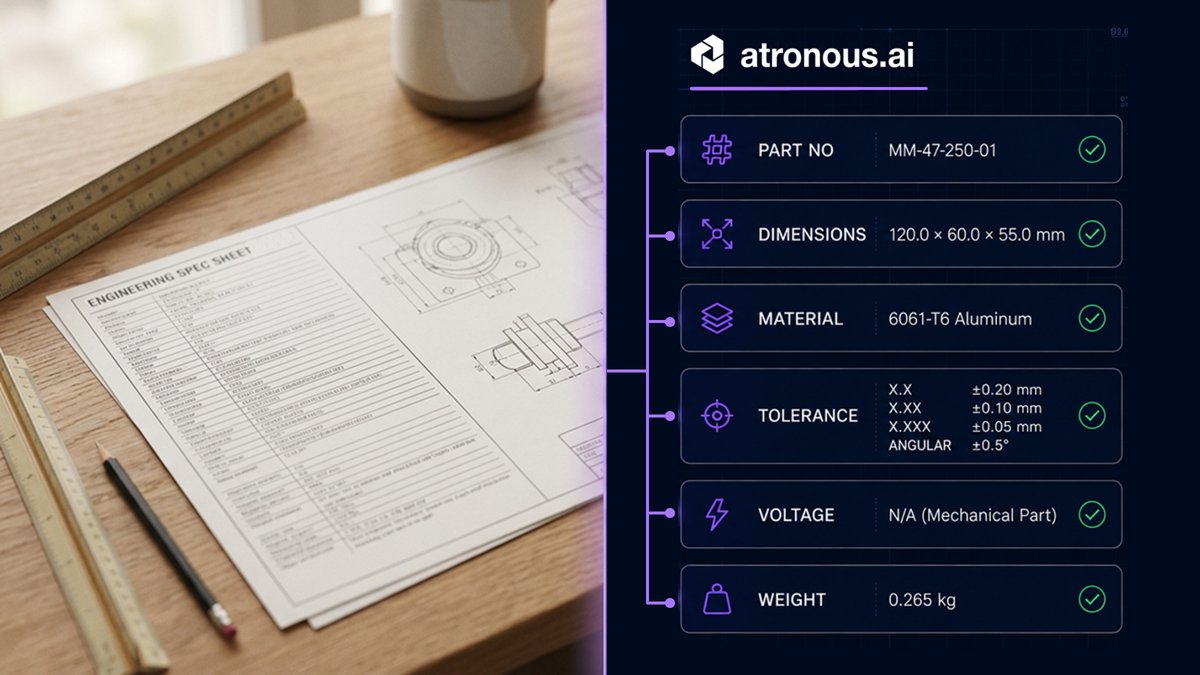
Depth is concrete here. A single delivery run can carry 63 product attributes per SKU, every one validated, which is a wide eligibility surface for the queries an agent might run. And the direction of the work goes further, toward derived intelligence: the attributes a product does not list but an agent needs, such as compatibility, use-case fit, and the characteristics that answer “what works with this.” That is data built around the product, not just about it, and it is where being chosen by a machine is won.
The results follow from the method. One mid-market HVAC manufacturer generated more than $660K in new revenue within 90 days and saw a 3x increase in marketplace selections. An enterprise run processed more than 50K records at a 98 percent-plus success rate, with a 100 percent identifier pass rate and zero duplicate identifiers. Work that used to take weeks for a few hundred SKUs now takes hours for thousands, with up to a 98 percent reduction in processing time. Those numbers were always the case for operational efficiency. In a web where the buyer is increasingly a machine, they are also the difference between being chosen and being skipped.
The takeaway
Ashkenazi is right that the billboard is giving way to the toll gate, and right that the payment networks will take their cut beneath it. Both of those are being built by other people, at the door and at the till. The part left for everyone who sells a product is the part in the middle, the decision, and that decision is made on the depth and accuracy of your attributes.
The advertising web is wrestling with what it loses when the audience stops being human. Commerce gets to ask a better question. When the buyer is a machine, comparing products attribute by attribute and deciding in milliseconds, does your product carry enough verified data to be eligible, trusted, and chosen?
Intelligence in every attribute.