Product Taxonomy: How to Classify Products into the Right Category
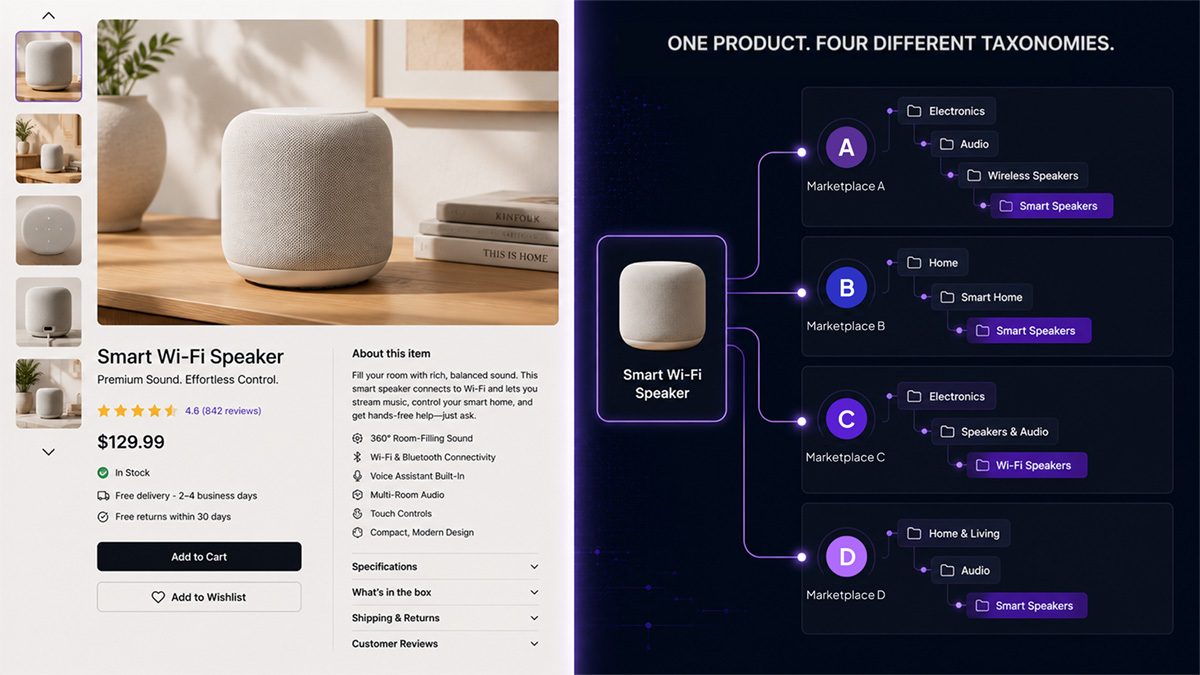
Every product you sell lives somewhere in a category tree. Where it lives decides where it shows up: in navigation, in filtered search, in comparison results, and in what an AI agent retrieves. Classification is not clerical work. It is placement on the shelf of every digital channel at once.
This guide is about classifying products into a taxonomy that already exists, yours or a channel’s. Designing that tree is a different job, and it appears here only where it changes how you classify. What follows: how retail taxonomies are structured, a repeatable way to classify any product, and worked examples for the products people ask about most.
What a retail product taxonomy is
A taxonomy is the hierarchy of categories a retailer or marketplace uses to organize its products. Most run three to six levels deep, from a broad department down to a specific leaf category:
- Clothing → Men’s Clothing → Socks → Athletic Socks
- Electronics → Cables & Adapters → HDMI Cables
Three things make retail taxonomies harder than they look. First, every channel maintains its own. Amazon, Walmart, Wayfair, and Google’s product taxonomy each slice the same universe differently. Second, the leaf category is load-bearing. It determines which attributes are required, which filters a product appears in, and often which fees apply. Third, the tree is a merchandising artifact, not a logical one. A merchandiser will not open a node for three products, so those get folded into a broader node alongside similarly purposed items. The tree you are classifying into is uneven by design, and the category you expect to find may not exist.
Why classification goes wrong at scale
Classifying one product is easy. Classifying fifty thousand is where teams break, because the rules change with every category. Each node carries its own attribute requirements, allowed values, and naming conventions. A rule that is correct for office furniture is a defect when applied to writing instruments.
Misclassification is quiet damage. The product still exists, but it sits in the wrong aisle. It misses the filters shoppers actually use, surfaces next to the wrong competitors, and gets rejected or suppressed by marketplaces that validate category fit.
How to classify a product, step by step
- Start from attributes, not intuition. Collect what the product actually is: type, material, intended use, dimensions, audience. Classification decisions are attribute decisions.
- Find the candidate leaf categories. Search the target taxonomy for the product type and its synonyms. There are usually two or three plausible homes, because the tree was drawn by merchandisers, who have to factor for assortment depth and product affinity.
- Let the intended use break the tie. Most classification mistakes come from picking a category that describes the product’s form instead of its use. Shoppers browse by use.
- Check the leaf category’s rules. Read the required attributes for the node. If the product cannot fill them, you are probably in the wrong node.
- Record the mapping and the reason. When the same catalog goes to a second channel, a documented category mapping is the difference between a lookup and a do-over.
Worked examples
Socks, sold in multipacks. The product is “men’s athletic crew socks, 6 pairs.” The leaf is Athletic Socks, not a generic Socks node, because athletic is the shopping intent. The multipack is not a category decision at all; it is a unit-count attribute. Classifying multipacks as their own category is one of the most common apparel mistakes.
An HDMI cable. Form says “cable,” but taxonomies split cables by connector. The right home is Electronics → Cables & Adapters → HDMI Cables, and the connector type, length, and standard version are the attributes that justify the placement. Put it in a generic accessories node and it disappears from every connector-type filter. Then look past the node: two cables in the same leaf can price five times apart. The difference is use case. One is a certified high-bandwidth cable built for commercial installs and home theaters. The other is a basic cable that is perfectly fine for a desktop PC. Bandwidth, certification, and rated length are the attributes that justify the price and win the specific query.
An exercise mat. The same physical mat can be a yoga mat, a fitness mat, or a play mat, and many taxonomies carry all three. Intended use and thickness decide it. A 4 mm mat belongs with yoga; a 15 mm high-density mat belongs with training equipment. And use goes deeper than the node. People now search for a mat that is kind to knees, or an extra-long version for taller users. Cushioning, joint support, and length are the attributes that answer them, but only if they are captured as data instead of buried in a description.
Large storage containers. A 27-gallon tote lands under Home Storage & Organization for a general retailer and under Material Handling for an industrial channel. Neither is wrong. This is why mappings are per-channel: one catalog, several correct answers, each with its own required attributes.
Classification gets you found. Use cases get you chosen.
Search behavior is changing underneath the taxonomy. In AI Overviews and LLM search, people do not type “handbag.” They ask for the smallest handbag that will hold an iPhone 14. They ask for a yoga mat for older adults with knee pain, or an HDMI cable that will not fail in a conference room. The query arrives with the use case built in.
A category node cannot answer those questions. Attributes can. Internal dimensions answer the handbag question. Cushioning and length answer the knee question. Bandwidth and certification answer the conference room. These are use-case attributes: the layer of data around the product that says who it is for and what job it does, not just what it is. They are exactly what agent-ready attributes and AEO are about, and we went deeper on how agents run those queries in AI Agents Shop on Attributes.
This is where classification work pays twice. The same attribute discipline that places a product in the right node is what makes it eligible for the specific, high-intent queries AI search now carries. A product with validated use-case attributes can be the answer. A product without them is not in the running.
One catalog, many taxonomies
The hard version of this problem is not classifying a product once. It is keeping one catalog correctly placed across every channel’s tree at the same time, as those trees change. That is product classification as an ongoing operation, not a project. Marketplaces reject or suppress listings that fail category validation, so every taxonomy update at every channel becomes work.
Where machine classification fits
At catalog scale, classification is a matching problem, and it is one machines are good at. Models using embeddings can read a product’s attributes and description and place it in a retailer’s tree with high confidence, flagging the uncertain cases for review instead of guessing. We covered the approach in our engineering write-up on how the classification pipeline works.
The machine alone is not the answer, though. A prediction still has to respect each category’s rules. That is a validation problem, not a generation problem, and the two should never be conflated.
How we do it at atronous
atronous classifies products with machine learning, then validates every placement against the target category’s own rules before anything is delivered. Our constraint engine covers more than 400 product categories, each with its own independently enforced vocabulary, and every record can pass through up to seven validation checks before delivery. The result is a catalog that lands in the right node of every channel’s tree, with the attributes that node requires, and documented reasons behind each mapping. The direction of the work goes further: deriving the use-case attributes, such as fit, capacity, and compatibility, that let a product answer the specific questions AI search now asks.
Classification decides whether your products are found. Use-case attributes decide whether they are chosen. Validation decides whether they are trusted. Doing all three, at scale, is the difference between a catalog that exists and a catalog that sells.
See where your own products land. Send up to 50 SKUs through a free Data Quality Assessment, and we will return them classified, validated against each category’s rules, with the exceptions flagged and the reasoning documented.
Intelligence in every attribute.