What Product Data Enrichment Actually Requires
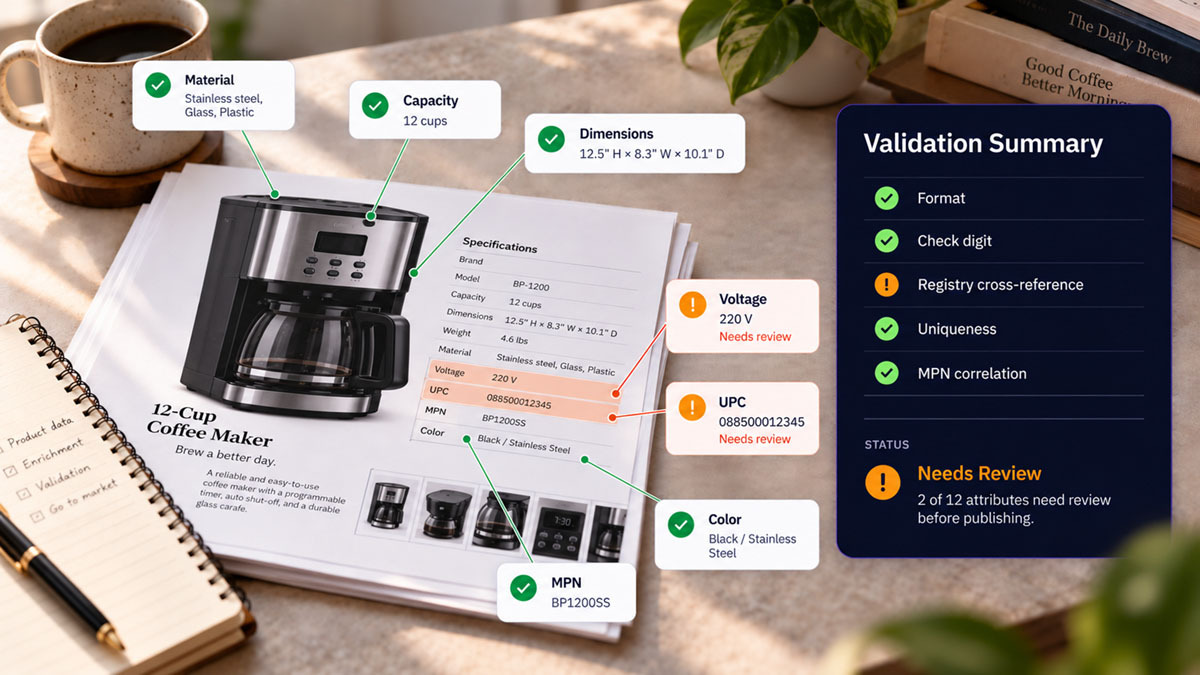
Most teams treat enrichment as a content problem, filling in what is missing. The requirement that decides whether it works is the one most tools skip: the data you add has to be correct for the category it lands in.
Product data enrichment is the work of taking raw or incomplete product records and making them complete, structured, and accurate enough to sell against on every channel that reads them. That is the definition most teams would agree on. The disagreement, and the reason so much enrichment work fails quietly, is about which of those three words carries the weight. Most tools optimize for complete and structured. The word that decides the outcome is accurate.
Adding data is the easy part. Almost any modern tool can generate a description, fill an empty attribute field, or map a record to a marketplace template. The hard part, the part that separates data that sells from data that gets rejected, is generating the right value, within the rules of the right category, and knowing it is right before the record ships. That is what product data enrichment actually requires, and it is where most of the market stops short.
What most teams mean by enrichment
In common use, enrichment means filling gaps. You start with a thin record, a name, a price, maybe an image, and you add to it: a longer description, structured attributes, specifications, better images, category tags, and the fields each marketplace demands. Content-generation tools and PIM platforms have made this faster every year. The volume problem is largely solved. You can produce thousands of enriched records in the time it used to take to finish a few hundred.
This is necessary work. Thin records do not convert, and incomplete records do not get accepted. But volume is only half of the requirement, and it is the half that generic tools already handle well. Producing more data is not the same as producing correct data. A record can be complete, well formatted, and confidently wrong.
The requirement everyone skips: the data has to be right for its category
Every product category carries its own rules. Allowable variant dimensions, attribute vocabularies, unit-of-measure conventions, identifier formats: each of these is specific to the category, and a value that is correct in one category is a defect in another. A color normalization rule written for office furniture becomes an error the moment it is applied to writing instruments. Multiply that across hundreds of categories, each with its own constraints, and the complexity moves past what a person, or a generic model asked to enrich a catalog, can hold in view at once.
This is why enrichment that adds unvalidated values does not simply leave errors in place. It scales them. Every attribute generated without a check against the category’s rules is another way to introduce a defect that no one sees until a marketplace rejects the listing, or worse, until the listing is live and quietly wrong. Generating an attribute is straightforward. Generating the right attribute, within the right constraints, for the right category, with correctness you can trust at scale, is the unsolved problem. It is the actual requirement hiding inside the word enrichment.
What product data enrichment actually requires
Stated plainly, four things have to be true for enrichment to be worth doing.
-
A category-aware constraint layer. The rules that govern each category have to be encoded and enforced independently, so a rule that is correct for one category cannot contaminate another. Without this, enrichment is guesswork that happens to be fast.
-
A separation of generation and validation. Generating a value and confirming it is correct are two different jobs, and the same pass should not do both. Generation ranges across an enormous space of possible values, which is where AI is strong. Validation is a separate discipline, and it works on two levels. Deterministic checks settle everything a rule can decide, such as format, check digits, uniqueness, and required fields, where a value either passes or it does not. Semantic checks handle what rules cannot. They read across the whole record and catch conflicting or implausible claims that are each well formed on their own but do not agree with one another. A material described one way in the title and another way in the attributes is not a format error, and only a check that reads for meaning will catch it. When generation and validation collapse into a single step, you get confident output with nothing standing behind it.
-
Identifier and completeness gates, applied before delivery. UPC and EAN check-digit validation, duplicate detection, and required-field audits are the deterministic checks that catch the errors that cost the most, and they have to run before a record ships, not after go-live. A record that fails should be flagged and documented, not silently dropped and not silently passed.
-
Accuracy over coverage. Given the choice, a validated subset with clearly flagged exceptions is more valuable than a complete file with hidden errors. Delivering ten thousand records you can stand behind, with the gaps documented, is a success. Delivering thirteen thousand with errors buried inside is the kind of failure that surfaces after it is expensive to fix.
None of these is about adding more. Each is about making sure that what you add is correct, and that you know it is correct before it becomes someone else’s problem downstream.
Why this matters more as AI agents enter the picture
For years the reader of a product listing was a human who could forgive a gap or infer around a vague spec. That is changing. As AI agents take on more of how products are found, compared, and recommended, the reader is increasingly a machine that does not browse. It computes. It compares products attribute by attribute, and it acts on the structured data it is given, not on the photograph a person would have squinted at. Grove Ventures partner Renana Ashkenazi, writing in Forbes, marked the point at which automated visitors became the majority of web traffic. In that setting an unvalidated attribute is not a soft gap. It is a wrong answer an agent will read, trust, and act on.
This raises the bar for enrichment rather than lowering it. The catalog is becoming the authoritative source that agents read and compare against, and a source is only as useful as it is trustworthy. Enriching a record with data that has not been validated does not prepare it for that world. It only makes the record easier to find and more likely to be wrong.
The takeaway
The useful way to think about product data enrichment is not as a content exercise but as a correctness one. Adding data is the baseline. Adding data that is right for its category, validated before it ships, and kept right as it flows to every channel and every agent that reads it, is the requirement that actually matters. That is the difference between a catalog that scales and one that scales its errors.
Atronous is built for that requirement. It generates product data across the full space where AI is strong, then validates every record against category-specific rules that no single pass of generation could enforce on itself. Each record moves through multiple independent checks, deterministic and semantic, across a constraint layer that spans 400+ product categories, before atronous activates the verified data into the systems that carry it forward.
Start with a conversation about your product data.
Intelligence in every attribute.
Frequently asked questions
What is product data enrichment?
Product data enrichment is the process of taking raw or incomplete product records and making them complete, structured, and accurate enough to sell against on every channel that reads them. It covers generating missing attributes, descriptions, and specifications, and, done properly, validating every added value against the rules of the category it belongs to.
What does product data enrichment require?
Four things: a category-aware constraint layer, so rules from one category cannot contaminate another; a separation of generation and validation, so AI generates values and independent checks confirm them; identifier and completeness gates that run before delivery, not after go-live; and accuracy over coverage, because a validated subset with flagged exceptions is worth more than a complete file with hidden errors.