eCommerce Product Tagging: What Good Looks Like
Most tagging guidance stops at advice like use descriptive tags, keep them consistent, and review them regularly. That is not a standard. It is a wish. Good product tagging is a controlled vocabulary, governed per category, validated before it ships, and legible to the systems that increasingly do the searching.
Product tagging is the practice of attaching labels to a product record so that people and systems can retrieve, filter, group, and merchandise it. That much is uncontroversial. The reason so many tagging projects quietly fail is not that teams disagree with the definition. It is that tags are the easiest thing in a product record to create and the hardest thing to govern, so catalogs accumulate them faster than anyone can maintain a standard for them.
The result is familiar to anyone who has inherited a large catalog. Thousands of tags, no vocabulary behind them, filters that return the wrong set, and no one willing to delete anything in case something depends on it.
A tag, an attribute, and a category are three different things
Most of the confusion in this area comes from treating three distinct structures as one. They are not interchangeable, and the difference decides whether a catalog scales.
A category is where a product sits in a hierarchy. One product occupies one node, and the node determines which rules apply to it. This is taxonomy, and it is structural.
An attribute is a defined field with a name, a data type, a unit where relevant, and a set of allowable values. Sleeve length is an attribute. Voltage is an attribute. Water column rating in millimeters is an attribute. Attributes are what marketplaces validate against and what comparison engines read.
A tag is a label attached to a record for retrieval or merchandising. It may correspond exactly to an attribute value, or it may be something no attribute schema would ever hold, such as a seasonal campaign grouping or an internal merchandising flag.
Trouble starts when tags are used as a substitute for attributes rather than a layer on top of them. A tag reading “waterproof” is not the same asset as an attribute recording a water column rating of 10,000 millimeters. The first is a claim. The second is a specification a buyer can compare and a channel can validate. Catalogs that put claims where specifications belong end up unable to answer the questions that decide purchases.
Where tagging actually goes wrong
The failure modes are consistent across categories and across the size of the business.
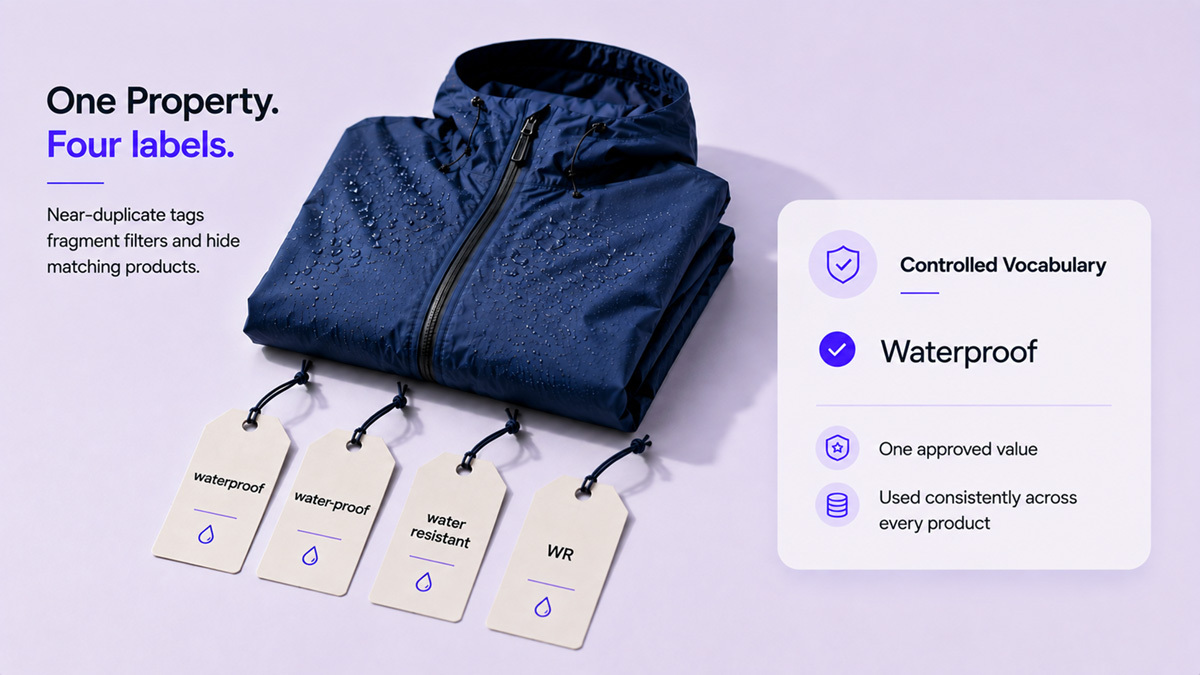
Free text creates near-duplicates. Left ungoverned, one concept becomes four labels: waterproof, water-proof, water resistant, WR. Every one of them is reasonable. Together they split a filter into four checkboxes, none of which returns the full set of matching products. The shopper concludes you carry three waterproof jackets when you carry sixty.
Tags get applied at the wrong level. Merchandising tags are the usual offender here, because they are applied in bulk and rarely checked against the variants underneath. Clearance attached to the parent product when three of eleven sizes are actually reduced is technically true and practically broken: the shopper filters for clearance, lands on the page, and finds the size they want at full price. Anything that varies by variant has to live at the variant level, whether it is an attribute or a tag derived from one. Level errors are invisible in an audit that only counts whether a field is populated.
Marketing labels and factual values share a field. Bestseller, summer edit, and clearance end up in the same tag field as material composition and closure type. Once that happens, no downstream system can trust the field, because it cannot tell a fact from a campaign.
Nobody retires anything. Tags are created constantly and deleted almost never. Seasonal groupings from three years ago persist. Tags applied to two products each accumulate in the thousands, none of them useful for filtering, all of them noise in any system that reads the field.
Vocabulary drifts silently. A field that should hold twelve allowed values holds four hundred, and no one notices, because nothing in the pipeline is watching the count. This is the failure that compounds fastest, and it is the easiest to detect if anyone is looking.
What good looks like
Stated plainly, five things have to be true for tagging to be worth doing at scale.
- A controlled vocabulary, defined per category. Every field that should be closed has an explicit list of allowed values, and that list belongs to the category rather than to the catalog as a whole. Sleeve length is a meaningful vocabulary for outerwear and meaningless for cookware. A single global tag list applied across hundreds of categories guarantees that most of it is wrong most of the time.
- Tags that resolve to attributes wherever an attribute exists. If a value can be expressed as a structured attribute with a type and a unit, it should be, and the tag should be derived from it rather than typed independently. Derived tags stay consistent with the specification. Independently typed tags drift away from it within a season.
- The right level, deliberately chosen. Product, variant, or asset. Each tag needs an explicit level, and the level has to match how the channel and the site render the result. This single decision resolves the majority of filter complaints in an apparel or furniture catalog.
- Provenance and a timestamp on every value. Where did this tag come from: a vendor feed, a generated pass, a merchandiser. When. Without provenance you cannot audit a bad value back to its source, and a correction fixes one record rather than the rule that produced ten thousand.
- Validation before the tag reaches a channel. A tag outside its category vocabulary, at the wrong level, or contradicting a structured attribute on the same record is a defect, and it is cheap to catch automatically and expensive to discover after go-live. Generation and validation are separate jobs, and the same pass should never do both.
None of these is about producing more tags. Each is about making the tags you already have mean something specific and stable.
How to tell whether your tags are working
Most teams measure tagging by coverage, the share of products carrying tags. Coverage is the least informative number available. Four measures say considerably more.
Vocabulary size against the expected size. Count the distinct values in each closed field. A field designed for twelve values holding four hundred is drifting, and the ratio tells you how far.
Orphan rate. The share of tags applied to fewer than a handful of products. High orphan rates mean the vocabulary is being invented at the point of entry rather than selected from a list.
Filter yield. How often a filter selection returns zero results, or returns products that do not belong. This is the measure closest to lost revenue, and it is usually available in site analytics without any new instrumentation.
Contradiction rate. How often a tag disagrees with a structured attribute on the same record. A record tagged waterproof with no rating attribute, or tagged cotton beside a material field reading polyester, is a record no channel and no agent should trust.
These four are more work than reading a coverage percentage. They are also the ones that predict whether a product gets found, which is the dimension of data quality most dashboards leave out entirely.
Why this matters more as AI agents enter the picture
For most of the history of eCommerce, the reader of a product tag was a person using a filter, and a person can work around a messy vocabulary. They try a different filter, or they scroll. As AI agents take on more of how products are found and compared, the reader is increasingly a system that does not scroll. It reads the structured values it is given and it computes on them.
In that setting, four near-duplicate labels for one property are not an inconvenience. They are four weaker signals where there should be one strong one, and a product that does not match cleanly is a product that does not enter the comparison. This is where tagging stops being a merchandising chore and becomes part of whether a catalog is readable by the systems doing the recommending. The direction of travel is clear even though the outcomes are still being written, and the preparation is the same work that improves human filtering today.
The takeaway
Tagging is not a content exercise and it is not a volume problem. It is a vocabulary problem with a governance layer on top. A catalog with fewer, well-defined, validated tags outperforms one with many, because every tag in the first catalog means one thing and every filter built on it returns the right set.
Atronous treats tags the way it treats every other value in a product record. Values are generated across the space where AI is strong, then validated deterministically against the vocabulary of the category they belong to, across a constraint layer spanning 400+ product categories, each enforced independently. A typical enterprise run surfaces 18 distinct categories of data quality issue and returns each with its rationale rather than dropping it in silence. Verified records are then delivered to the PIM, ERP, and downstream systems that carry them forward.
Start with a conversation about your product data, or send a sample and see the vocabulary problems in your own catalog measured and returned.
Intelligence in every attribute.
Frequently asked questions
What is a product tag?
A product tag is a label attached to a product record so that people and systems can retrieve, filter, group, or merchandise it. A tag may be derived from a structured attribute value, such as color or material, or it may hold something no attribute schema would carry, such as a seasonal grouping or an internal merchandising flag. The distinction matters: tags support retrieval, while attributes carry the specification that channels validate and comparison engines read. A property that belongs in an attribute should be recorded as one and the tag derived from it, never typed independently as a tag.
What is the difference between a product tag and a product attribute?
An attribute is a defined field with a name, a data type, a unit where relevant, and a set of allowable values, such as a water column rating measured in millimeters. A tag is a label used for retrieval and merchandising, such as "Mother's Day Gift". Good practice derives tags from attributes wherever an attribute exists, so the two cannot drift apart. Using tags in place of attributes replaces comparable specifications with unverifiable claims.
Do product tags help SEO?
Well-governed tags help indirectly, by improving internal search, filtering, and the structure of the pages that get indexed. Ungoverned tags hurt, because near-duplicate values fragment collection pages, create thin or near-empty pages, and split the signal across several weak URLs instead of one strong one. The determining factor is not how many tags exist but whether they come from a controlled vocabulary that maps cleanly to how shoppers and search engines describe the product.