Where Product Knowledge Gets Lost Before It Reaches the Shopper
Over the past three months, I have talked with heads of e-commerce, digital directors, CTOs and marketing leaders at apparel, footwear, beauty and luxury companies. I expected to talk about AI. Most conversations started with spreadsheets, interns and handoffs instead.
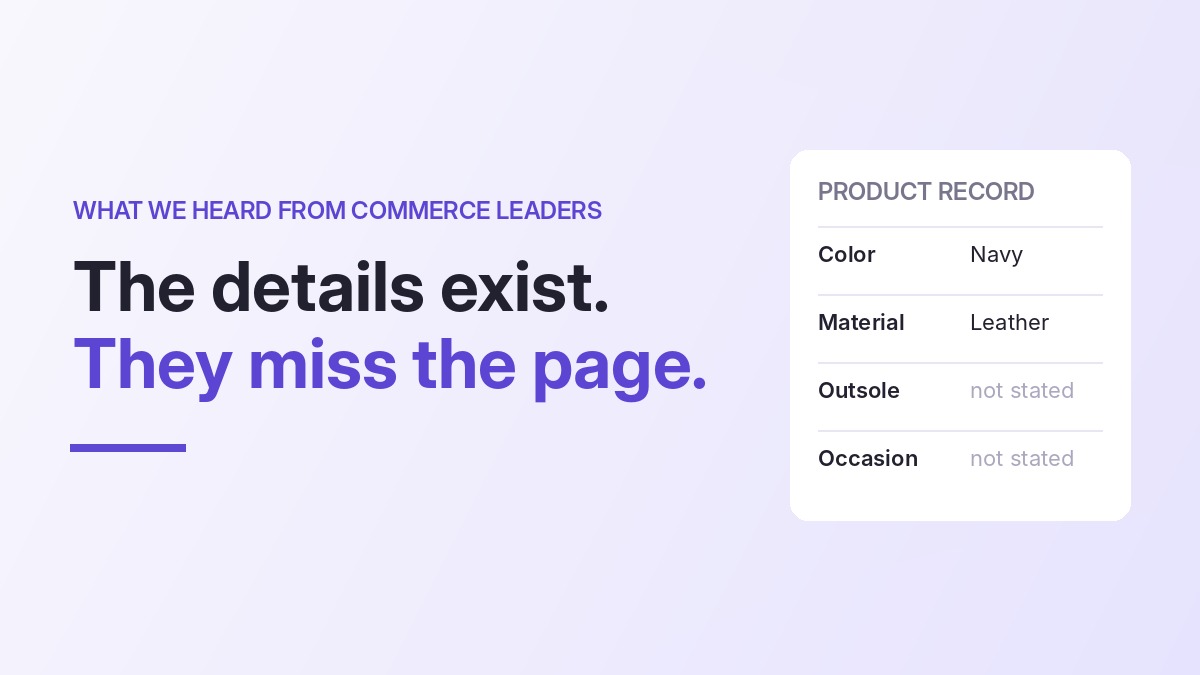
The pattern was hard to miss. The details that sell a product usually exist somewhere inside the company. They just do not make it to the product page, where a shopper could find them and decide.
The spreadsheet is still the source of truth
Almost every team I spoke with runs on spreadsheets, whatever its size or age. One long-established women’s apparel brand writes every customer-facing description by hand in Excel, then imports it into the storefront. A luxury house keeps its master product file on a shared drive, and the product team fills in fields after the fact, often with interns. A fast-growing direct-to-consumer brand with a sophisticated data warehouse still keeps its item master in a locked spreadsheet that one person can edit.
As one of my colleagues said on a call, spreadsheets might be the greatest software ever made. But a spreadsheet records values. It does not record why a product exists, who it is for, or what makes it special.
Knowledge gets lost at the handoff
The story I keep coming back to came from a footwear marketing leader. While preparing to launch a new version of a popular shoe, he discovered a traction feature built into the outsole. It was a real selling point, and nobody had mentioned it during months of development.
His read was that once a team decides to make a shoe, it slowly forgets why. By the time it reaches marketing, the answer to “who is this for?” is “it is cute.” That is not a people problem. There is simply no place where the reasoning gets captured as the product takes shape.
We heard versions of this everywhere. At one apparel brand, design knowledge lived in senior designers’ heads and in printed binders, and it left when the team turned over. A women’s fashion retailer that releases new product every two weeks sets up a reissued blazer from scratch, as if it had never sold it before. Merchandisers hand-tag products for a gift guide theme like “embellished,” because no system can answer that question on its own.
Vendors have the details. They just do not send them.
Retailers see the same gap from the other direction. A beauty retailer’s e-commerce leader found a national brand’s listing on a large marketplace with richer content than the brand had sent her. Getting attributes like “good for curly hair” or “vegan” out of vendors is, in her words, like pulling teeth.
Private label has its own version of the problem. The same retailer has strong product developers, but no in-house copywriters to turn formulas into pages that sell. Another retailer that resells footwear brands sends vendors a custom template, waits, and often ends up copying details from the vendor’s own website.
Consistent, not identical
Brands that sell through retailers face a subtler version. A footwear brand with well over a thousand retail partners wants every one of them telling the same story: support, style, versatility and comfort. It does not want every retailer publishing the same copy word for word. And as the brand opens new regions, its concern is simple. If it does not give distributors clear, ready-to-localize messaging, they will fill the gap themselves.
What it costs
The cost shows up in two places. The first is sales. When the detail that answers a shopper’s question is missing, the product does not come up in search, or the shopper leaves without deciding. The second is time. One luxury digital director estimated his team spends more than three months a year preparing product data for collection launches. He recently keyed in a collection himself, for the first time in a decade, just to see where the process breaks.
What we would tell any team in this position
None of the leaders I spoke with asked for more AI-generated copy. What they want sounds simpler, and is harder.
Capture what makes a product special before the handoff, not after launch. Keep one trusted record for each product, so the website, every retail partner and every region tell the same story in their own voice. Make the catalog remember what it already knows, so a reissued style starts from its predecessor. And let small teams spend their time reviewing product data rather than typing it.
That is the work atronous does. We improve the product data a team already has and add the attributes that shoppers, site search and AI agents look for, so more products are found and chosen. One multi-category distributor we work with raised attribute completeness across its catalog from 40% to over 90%.
If any of these stories sound familiar, I would love to compare notes. And if you want to see where your own pages stand, request a free C-Score on up to three of your product pages.