Why HVAC Listings Fail on Compatibility, Not Copy

A contractor at the counter and a contractor on your website are asking the same question: will this part work in that system. Everything else is secondary. Price matters, availability matters, but the answer to that one question decides whether there is a sale at all. Most distributor product data is built to describe products. In HVAC, describing the product is the easy half.
Distributors know their data needs work. That is not the gap. The gap is what they believe the problem is. Most treat it as a content problem, something a writer or an intern or a better template can fix. It is not a content problem. It is a constraint problem, and HVAC has harder constraints than almost any category in distribution.
Here is where it usually goes wrong.
Vendor data is not an onboarding project
A distributor does not have one catalog. It has a hundred or more vendor catalogs wearing a single logo. Specifications arrive as spec sheets, submittals, installation manuals, and price books, each in whatever shape the manufacturer happens to use, each on its own schedule. One vendor sends a clean spreadsheet. The next sends a 40 page PDF with the dimensions in a line drawing. The one after that sends a link to a portal.
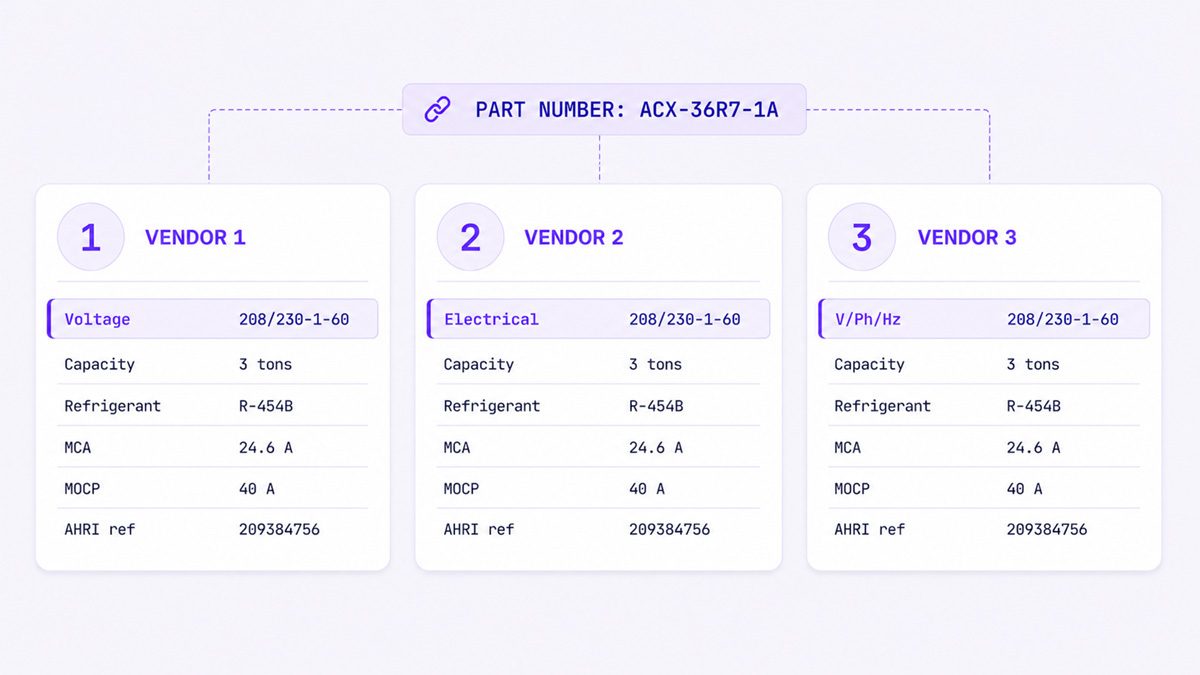
That is not a backlog to clear. It is an inbound stream that runs whether or not anyone is assigned to it. Every season brings revised price books, new model lines, discontinued items, and superseded part numbers. A cleanup project finishes and the catalog immediately begins needing fresh updates. Teams that plan for a project keep rediscovering the same problem every spring, and they keep budgeting for it as though it were unusual.
The distributors who get this right stop scheduling cleanups and start running a pipeline.
In HVAC, the attributes are the product
Nobody buys a condensing unit because the description reads well. They buy it because it is three tons, 208/230V single phase, running the right refrigerant, matched to a specific coil and air handler, with an AHRI certified reference number that proves the match. Capacity, voltage and phase, refrigerant, minimum circuit ampacity, maximum overcurrent protection, connection sizes, cabinet dimensions, airflow, efficiency rating. Those attributes are not metadata about the product. In this category they are the product.
This is why so many HVAC listings underperform without anyone being able to say why. The copy is fine. The photography is fine. The attribute that the buyer actually filters on is missing, or it is present in a format the filter cannot read, so the product never enters the comparison. A record that does not surface cannot be evaluated. It just quietly does not sell.
The cost of a wrong attribute is worse than the cost of a missing one. A missing spec loses a sale. A wrong voltage or a bad cross-reference ships, gets carried onto a roof, does not fit, and comes back as a return, a callback, and a contractor who orders somewhere else next time.
Supersessions make this harder than it looks. Part numbers get superseded constantly, and the replacement is often not a simple one to one swap. If the record does not carry the cross-reference, a search on the old number returns nothing at all. The contractor does not conclude that the number changed. They conclude you do not stock it.
Fill rate will tell you the record is finished
The most common measure of product data quality in distribution is fill rate, the percentage of fields that are not empty. It is easy to compute and it feels like progress. It is also the number most likely to say the catalog is healthy right up until a channel rejects half of it.
Fill rate cannot tell the difference between a populated field and a usable one. It counts “Voltage: 230” as complete when the category requires 208/230-1-60. It counts a capacity of “3” as complete when the unit of measure is missing and the value could be tons, or kilowatts, or nothing at all. Completeness only means something when it is scored against what the category requires, not against what the template happens to ask for. There are six other dimensions worth measuring, and the one that decides whether a product gets found is not on most dashboards at all.
The move to A2L refrigerants was the stress test
The industry shift toward lower global warming potential refrigerants such as R-454B and R-32 did something to distributor catalogs that no other change in recent memory did. It put two generations of equipment in the same catalog at the same time, with older inventory still selling through while the new lines came online.
Overnight, refrigerant type stopped being a line on a spec sheet. It became a filter, a compatibility rule, a compliance question, and a search term all at once. Every product family carrying it needed the attribute populated, validated, and consistent across every channel, on equipment that had been listed for years without anyone thinking hard about that field.
Distributors running a validated pipeline updated a rule and re-ran the affected categories. Distributors running spreadsheets went product line by product line, by hand, in season. Same regulation, same catalog size, very different quarter. The next change of that size is not scheduled, which is exactly the point.
Headcount is not a pipeline
The usual fix is people. Someone in merchandising owns vendor onboarding, an intern gets the summer backlog, a shared inbox absorbs the corrections. It works, in the sense that the work gets done, until volume moves.
The real cost is not the salary line. It is that assortment growth becomes capped by how fast a person can read a PDF. Adding SKUs means adding staff, so expansion decisions quietly become staffing decisions. That is a strange way to run a growth channel, and it is usually invisible in the numbers, because nobody reports the revenue from the products they decided not to list.
What good looks like
The fix is not a better template or another system of record. PIM platforms store and organize what you already have. They do not generate the attributes you are missing, and they do not validate values against the rules of the category they belong to.
That validation layer is the part that has to be automated, because the rules are category-specific and there are hundreds of them. A rule that is correct for air handlers is a defect when applied to controls. atronous maintains a constraint engine across more than 400 product categories, each carrying its own validation vocabulary, enforced independently. AI generates the content. Deterministic logic validates every value before anything is delivered. Identifiers are checked at a 100 percent format and check digit pass rate with zero duplicates. A typical enterprise run surfaces 18 distinct categories of data quality issues and returns each with its rationale, at a 98 percent or better success rate. Nothing is dropped in silence, and every rule change is logged by date, source, and reason.
The source documents come in as they are. atronous reads spec sheets, submittals, line drawings, and CAD files, then generates structured attributes from documents that were never built for eCommerce. Every product is classified into the right category before verified records are delivered to your PIM, ERP, and downstream commerce systems.
What that is worth, in this industry, is not theoretical. Tjernlund, an HVAC manufacturer, went from marketplace selections around 30 percent to over 90 percent. Listing work went from weeks for a few hundred SKUs to hours for thousands, and the company generated more than $660,000 in new revenue within three months. A multi-category distributor took attribute completeness from 40 percent to over 90 percent and cut time to market from three or four weeks to one or two days.
There is a second reason this is worth doing now. The contractor searching your site is no longer the only reader of your product records. AI agents are starting to answer product questions directly, and they do not browse a page. They read structured attributes and compare on them. A catalog built to answer the compatibility question accurately is already most of the way to being readable by those systems. A catalog that cannot answer it is not going to improvise.
See your own data measured
The fastest way to know where your product data stands is to see a sample of it measured and returned. That is what the atronous Data Quality Assessment does. It starts with a short call about your data and goals. Then you send up to 50 SKUs out of your PIM or ERP, exactly as they live in your system, and we run them through the same pipeline our enterprise customers rely on. Within five business days you receive the sample back, generated and validated, along with the taxonomy and schema recommendations behind the work and a working session to walk through what we found and what it means for your catalog at scale.
No pitch. Your own records, measured against the rules of their categories, so you can see exactly where the gaps are.
Book your Data Quality Assessment call, or see how atronous handles technical and industrial product data.
Intelligence in every attribute.
Frequently asked questions
What is HVAC product data?
HVAC product data is the set of attributes that describe a unit or part precisely enough for a buyer or a system to determine whether it fits an application. It covers capacity, voltage and phase, refrigerant, electrical requirements such as minimum circuit ampacity and maximum overcurrent protection, connection sizes, dimensions, airflow, efficiency ratings, certifications and AHRI match data, plus identifiers and superseded part cross-references. In HVAC the compatibility attributes carry the purchase decision, not the description.
Why do HVAC products fail to sell online even when they are listed?
Usually because the attribute the buyer filters on is missing, wrong, or formatted in a way the channel cannot read. A record that does not surface in a filtered search never enters the comparison, so it does not lose on price or availability. It is simply never considered. Measuring completeness against what the category requires, rather than counting populated fields, is what surfaces this before it costs a quarter of revenue.
How should a distributor measure product data quality?
Not by fill rate. Fill rate counts fields that are not empty and cannot tell a usable value from a placeholder. Measure completeness against category requirements, validity against format and check digit rules, consistency across fields that must agree, uniqueness of identifiers, accuracy against a source of truth, timeliness, and relevance to what the buyer is actually trying to decide.