Agents Are Only as Trustworthy as the Systems Behind Them
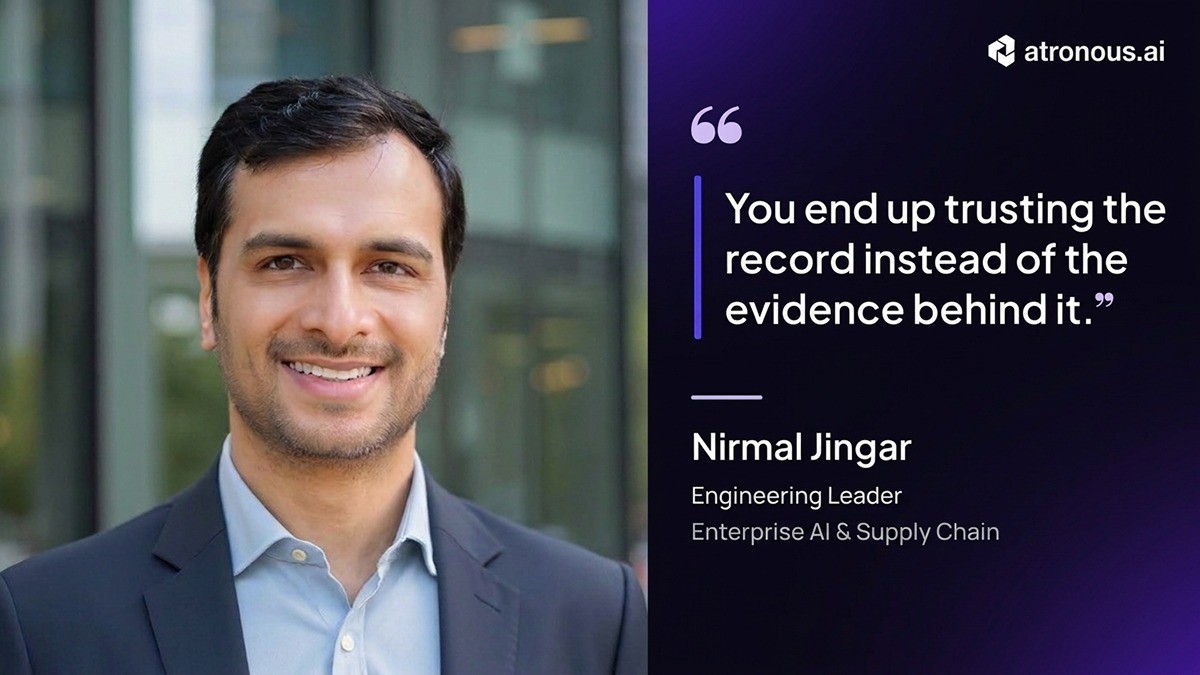
A conversation with Nirmal Jingar, Senior Engineering Leader for Enterprise AI and Supply Chain at Wayfair.
When we assess a catalog, one dimension gets less attention than the rest, and it is the one I keep coming back to. Provenance and traceability: every record carrying a versioned changelog, every rule logged with the date, source, and rationale behind it.
A record that is correct today, with no record of why it is correct, is a record you cannot defend tomorrow. As more of the buying decision moves to software, that stops being a governance nicety. It becomes the thing that decides whether a system can be trusted at all.
So rather than write about it again, I went and asked someone who has had to build for it.
Nirmal Jingar has spent his career building tier-one supply chain systems, covering buying, routing, delivery-date calculation, and network planning. He is a Senior Engineering Leader for Enterprise AI and Supply Chain at Wayfair, a Forbes Technology Council member, and a TEDx speaker who recently keynoted on cognitive supply chain. He has also open-sourced typedguard, a governance layer built to stop AI procurement agents from being manipulated by prompt injection.
Everyone building in agentic commerce right now is racing to ship the agent. Far fewer are asking the harder question underneath it: what happens when that agent reads a product record and has no way of knowing which fields were actually verified?
Here is what he told me.
The Conversation
What is today’s biggest hidden operational problem?
It’s not a system failure — it’s a decision failure. Most organizations still run on manual, unrecorded processes, and the context behind those decisions lives in people’s heads, not in any system. Everyone talks about technical debt. Almost no one talks about operational debt: the accumulated cost of decisions nobody wrote down, made by people who now can’t be automated around because there’s nothing to point the automation at.
Why is information now as important as inventory?
Inventory isn’t just a physical good anymore — it’s a digital representation. Software doesn’t see a sofa as a sofa. It sees a packing configuration, derived from dimensions, weight, and a dozen constraints. Getting that representation 100% accurate matters enormously, because small inconsistencies compound. If a system has the wrong height, width, or weight on file, you end up paying the wrong carrier fee, hitting capacity limits you didn’t plan for, or showing customers dimensions that don’t match what actually arrives. In e-commerce, everything runs on trust. Lose that, and you lose something very hard to get back.
Why does AI depend on high-quality data?
Data quality is foundational, but for agentic systems I’m increasingly concerned about context quality. An agent can have perfectly accurate data and still make the wrong decision if it doesn’t understand the business constraints surrounding that data.
That’s why I think enterprises need to move beyond data pipelines toward context systems — mechanisms that capture not only what a value is, but where it came from, how confident we are in it, what business rules apply to it, and which decisions it is safe to automate. You can fix bad data. What’s harder is building the domain context layer that lets an agent, or an orchestration system on top of it, actually make the right call with the data it has. Good data without domain context still produces bad decisions.
A system today has no way of knowing which fields in a product record were actually verified versus rushed through. How do we fix that?
This is really the provenance problem — and it’s connected to the decision-depth issue I mentioned earlier. If a field’s origin, verification status, and confidence level aren’t captured at the moment of entry, there’s no way to reconstruct that trust later. You end up trusting the record instead of the evidence behind it. The fix isn’t a bigger dashboard — it’s building the system so provenance is captured by default, not bolted on after the fact.
Why do manual product information processes still exist?
Because a lot of the industry still runs on Excel sheets, side documents, and one-off messages to a carrier rep — non-systematic decisions made ad hoc. Before anyone introduces AI or automation into that environment, the priority has to be connecting systems end-to-end, so there’s full visibility and a traceable flow of information that doesn’t depend on someone remembering to relay it.
As a leader, how do you get business teams to buy into more automated workflows?
I don’t lead with a suggestion. I try to figure out what’s actually causing them pain first, so they feel like their problem is being solved — not that a system is being imposed on them. Automation changes workflows, responsibilities, and sometimes people’s sense of control over a process. So adoption depends on trust. I start with a painful problem the business already wants solved, deliver a visible improvement, measure the outcome, and expand from there. The message should be “this helps you make better decisions,” not “this technology replaces you.”
That also applies to how business teams try to solve things themselves. Someone will say, “I built a workflow with a tool — can you just plug it into the supply chain?” But that one connection might touch ten other systems. That’s exactly where an engineering leader has to step in: not to say no, but to make sure a local fix doesn’t become a hidden liability three systems downstream.
What should leaders measure?
Resist the urge to invent a new dashboard for every agentic initiative. Start with the business metrics that already matter — cost, delivery time, inventory turns, recovery, SLA performance, customer experience. If an agentic system is creating real value, those numbers should move.
I would add one new category only: decision quality. How often did the system make the correct decision? How often did a human override it? How often did it correctly recognize that it lacked enough confidence to act?
The industry doesn’t need dozens of new AI metrics. It needs AI to improve the business metrics companies already care about.
What is your definition of agentic commerce, and what is it not?
Agentic commerce starts when software can pursue a genuine commercial objective — maximum recovery, customer experience, facility capacity — across a sequence of decisions, not just a single transaction. The value isn’t the word “agent.” It’s the system’s ability to navigate variables and operate inside guardrails to actually hit that objective.
What it’s not: a wholesale replacement for SaaS. Enterprise systems like SAP carry years of business logic and governance that isn’t going away — that work was already built, and rebuilding it isn’t the point. Agentic systems work best as complements: doing specialized tasks that make the existing system faster and sharper, not tearing it out.
When should an enterprise build an agentic workflow in-house versus buy from a vendor?
This debate predates AI and it isn’t going away because of it. Do you have the in-house engineering talent? Can you actually build it in the timeframe you need, especially if you want to be first to market? One mistake I see is assuming that access to a powerful foundation model eliminates the hard engineering work. It doesn’t. Production agentic systems still require deep domain knowledge, systems integration, evaluation, observability, security, and governance. The model is only one component of the architecture.
One prediction for the next few years?
Data provenance stops being a reactive log you check after something breaks, and becomes a standard, proactive layer. You’ll know who changed a value and where it came from before it causes a problem, not after. Systems move toward self-healing, proactively flagging that something is going to go wrong and suggesting the fix before it does. And decisions get more deterministic — rules, governance, and validation judges layered around the LLM, with a feedback loop back into the system. Quality and traceability are what will separate the systems people actually trust from the ones they just tolerate.
One piece of advice for supply chain leaders?
Don’t try to build an AI strategy for your entire operation at once. Ask a narrower question: which specific decisions are you actually willing to trust a machine to make? Pick one use case, take it fully agentic, and learn from it — monitor it, prove the business impact, and only then build the next piece. It’s a Lego-set approach: one production-ready block at a time. Models are changing fast, but the decisions your business actually needs to make don’t change nearly as quickly.
What I Took Away
Three things stayed with me.
Operational debt is the better name for the problem. We usually describe it as missing data. Nirmal describes it as decisions nobody wrote down, which is more precise and more uncomfortable. It means the gap is not in the catalog. It is in everything that was decided around the catalog and never recorded.
Context quality is a real distinction, and it is not the one most people are making. Accurate data that an agent misreads because it does not know the surrounding constraint is still a wrong decision. We keep hitting the same finding from the other direction: a field can be correct and still violate the rule that governs its category.
Provenance is moving from audit trail to precondition. His prediction is that it becomes proactive rather than reactive, known before a problem rather than reconstructed after one. If that is right, a catalog that cannot say where a value came from is not merely untidy. It is unusable by the systems that will be doing the buying.
See What Your Catalog Can Prove
If you are responsible for product data at scale, we offer a free data quality assessment. Send us a sample of your catalog and we will return a report on what we find: the identifier failures, the category mismatches, and the inconsistencies your team cannot see because they are filling in fields the way the template asked. There is no obligation attached.
Get your data quality assessment
My thanks to Nirmal Jingar for the time and the candor. You can follow his work on LinkedIn.