UPC Check Digits: What They Catch, and What They Miss
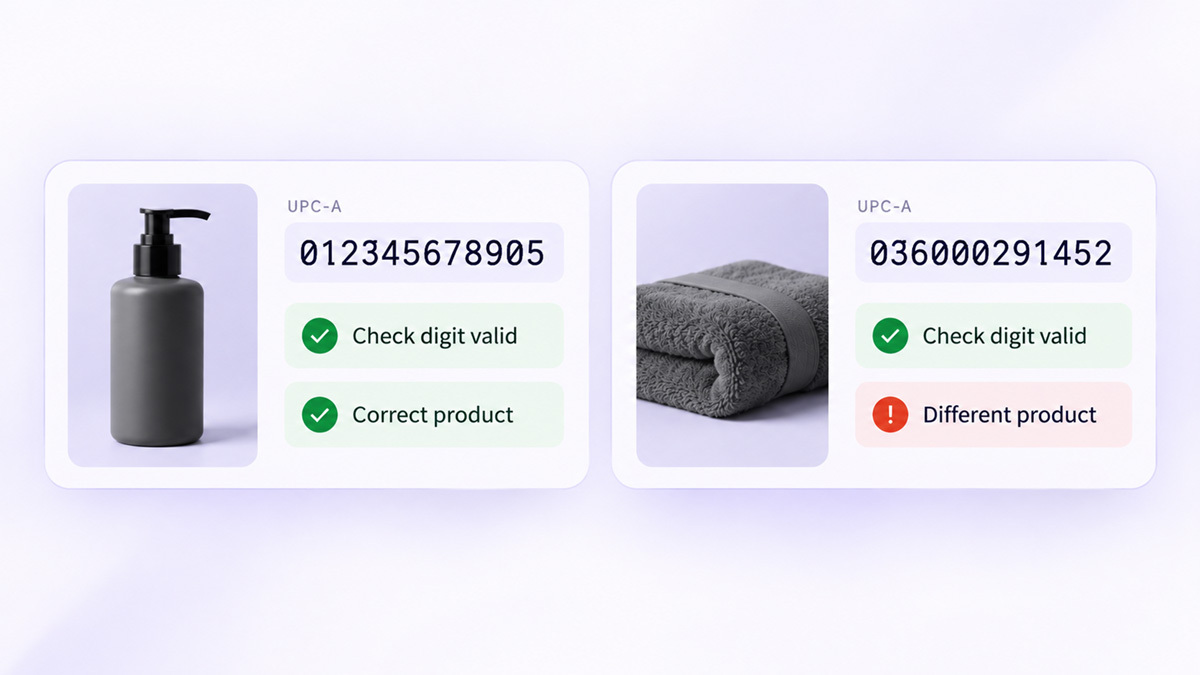
A UPC check digit is a transcription checksum. It was designed in an era of manual keying to answer one question: was this number typed correctly. It answers that question well. It was never designed to answer the question most catalogs are actually asking it, which is whether this number belongs to this product.
The distance between those two questions is where identifier problems live. A catalog can report a 100 percent check-digit pass rate and still carry duplicate identifiers, identifiers registered to another company, identifiers invented by a vendor, and identifiers that describe a case of twelve rather than the single unit on the page. Every one of those passes the algorithm. Any of them can cause rejection, suppression, incorrect matching, or merging at a marketplace.
What follows is what the check digit genuinely catches, what it provably misses, and what has to sit around it before an identifier can be trusted.
What the check digit actually does
The arithmetic is worth walking through once, because the failure modes fall straight out of it.
A GTIN-12, the twelve-digit number printed under a UPC-A barcode, carries its check digit in the final position. To calculate it, each of the preceding digits is multiplied by three or by one, alternating, then the results are summed and the sum is subtracted from the nearest equal or higher multiple of ten. A GTIN-13, which is what an EAN-13 encodes, works identically with the weighting shifted one position to account for the extra digit. The same scheme covers GTIN-8 and GTIN-14. GS1 publishes the calculation in full, and it has not changed in decades.
That alternating weight of one and three is doing all of the work, and it buys two specific guarantees.
Every single-digit error is caught. Change any one digit in the number and the weighted sum shifts by either one to nine or three to twenty-seven, and in neither case can the total land back on the same multiple of ten. This is a complete guarantee, not a probabilistic one. If exactly one digit was keyed wrong, the check digit will fail.
Most adjacent transpositions are caught. This is the one that is usually stated without its exception, and the exception matters.
The transposition the algorithm cannot see
Swap two neighboring digits and the weighted sum changes by twice the difference between them. A digit worth three times its value moves to a position worth one times its value, and its neighbor makes the opposite move. Call the digits a and b. Before the swap they contribute three a plus b. After the swap they contribute a plus three b. The difference is two times the quantity a minus b.
The check digit only detects the error if that difference is not a multiple of ten. Two times the difference is a multiple of ten exactly when the digits differ by five.
Which gives five specific pairs that transpose silently: zero and five, one and six, two and seven, three and eight, four and nine. Transpose any of those pairs in adjacent positions and the check digit still passes. The number is wrong, it is arithmetically consistent, and nothing in the validation objects.
This is not an obscure edge case. Ten of the ninety possible ordered pairs of distinct decimal digits, one ninth of them, transpose without detection. The rate you actually carry depends on your data, because real digit frequencies are not uniform. Any catalog assembled by hand over years is carrying some of these, and no amount of re-running the check digit will find them.
The point is not that the check digit is poorly designed. It is very well designed for what it does. The point is that a validation which passes tells you the number survived a specific and narrow test, and teams routinely read the pass as a much broader assurance than the test can support.
The failures a check digit cannot see at all
Everything above concerns numbers that were damaged in transit. The more expensive problems involve numbers that are perfectly intact and still wrong.
A valid identifier on the wrong product. One of the most consequential identifier defects in a large catalog is not a malformed code. It is a correct code sitting on the wrong record, usually from a copy-paste during a bulk edit or a vendor spreadsheet whose rows shifted by one. The number passes every format and checksum test available, because the number is fine. It simply describes something else.
Duplicates inside your own catalog. The same identifier on two records is not detectable by any per-record validation, because each record is individually valid. It only surfaces when something compares records to each other. Marketplaces do exactly that, and they respond by rejecting listings, merging the two products into one page, or suppressing both.
Recycled identifiers. GS1’s current rule is that a GTIN assigned to one trade item must not be reassigned to a different trade item, a position in force since December 2018. The exceptions are narrow: an item that was never produced, subject to a waiting period, and the reintroduction of the same unchanged item. Identifiers that predate the rule, or that came from vendors who never followed it, can still describe two different products across time. Nothing in the number records which product it was issued for.
Invented codes. Constructing a twelve-digit number with a correct check digit takes about a minute. Vendors under pressure to supply an identifier for a product that never had one sometimes do precisely that, and the resulting code validates flawlessly. Passing the algorithm is not evidence of registration, and the two are frequently confused.
Identifiers the company never licensed. The leading portion of a GTIN is a company prefix issued to a single licensee. Codes bought from third-party resellers carry somebody else’s prefix. Nothing about the number is malformed, and marketplaces that verify licensing against the issuing registry reject them anyway. The prefix digits do participate in the checksum, but the algorithm cannot determine who is licensed to use them.
The wrong packaging level. A GTIN-14 with a non-zero indicator digit commonly distinguishes a packaging configuration such as an inner pack or a case rather than the consumer unit. Put one on the item record and every arithmetic check passes while the listing describes twelve units and sells one. This is common in distribution, where the case code is often the one that appears in the ERP. Length alone does not settle the question: a fourteen-digit value in a database may equally be a GTIN-8, GTIN-12, or GTIN-13 padded with leading zeros, so the indicator digit and the source system both have to be read.
Restricted-circulation codes. Certain prefix ranges are reserved for restricted environments, including company-internal and geographically restricted applications. They are valid within those environments, which is what they are for. They are not intended to serve as globally unique marketplace identifiers. They reach marketplaces anyway, regularly.
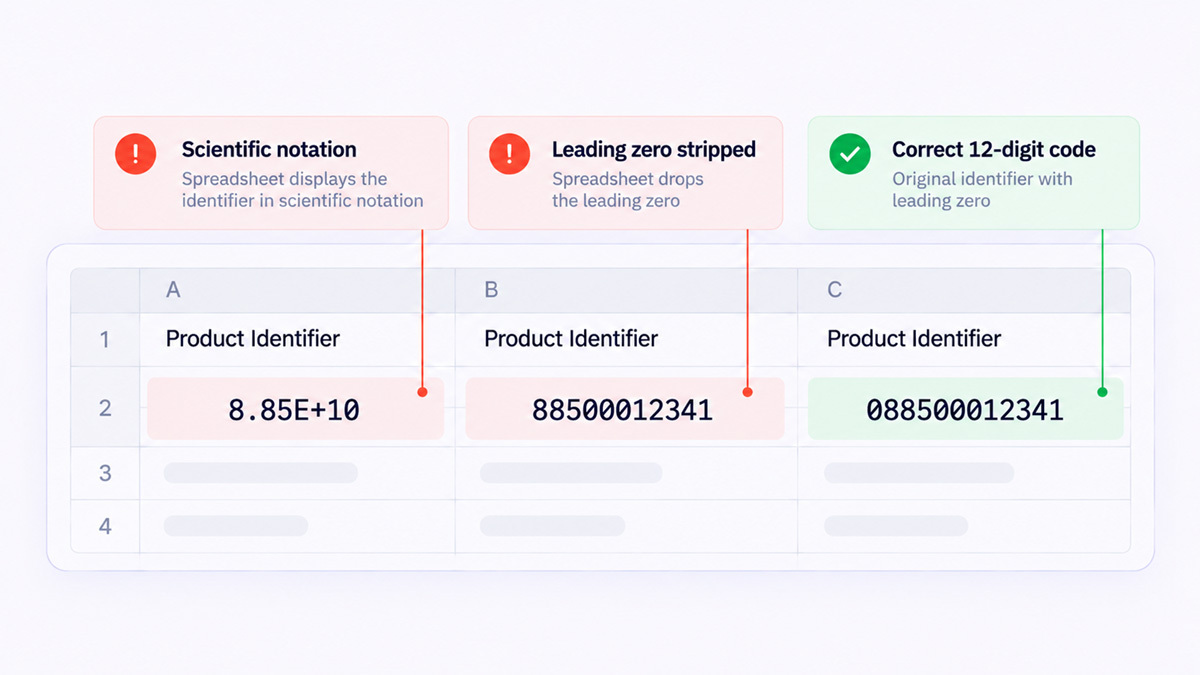
Codes damaged by a spreadsheet. This one is mechanical rather than conceptual, and it is among the highest-volume identifier defects in existence. Open a product file in a spreadsheet and a twelve-digit identifier is likely to be interpreted as a number rather than as text. Leading zeros can be removed, because numbers do not carry leading zeros, and a GTIN-12 that loses its first character becomes a different and invalid string. Longer codes may be displayed in scientific notation, which is a display behavior rather than damage in itself; whether the exact value survives depends on how the file was imported, how the cell is formatted, whether it was edited, and how it was exported. The risk worth managing is that none of this is visible on screen. GS1 commonly recommends a fixed fourteen-digit database representation to avoid the ambiguity entirely, with a GTIN-12 taking two leading zeros and a GTIN-13 taking one.
What validation has to look like instead
The through-line is that a check digit is a per-record, per-field test, and most identifier failures are relational. They are about the relationship between the identifier and the product, between one record and another, and between the identifier and the registry that issued it. No single-record test can reach any of that.
Identifier validation that reflects real risk has to do several things the algorithm does not. It has to confirm the format and the check digit, which is the part everyone does. It has to confirm the identifier is unique across the entire delivery rather than merely arithmetically consistent within its own row. It has to check the identifier against the registry that issued it, to confirm the prefix belongs to the licensee claiming it, and, where authoritative product data is available, to compare the registered product information with the record. It has to correlate the identifier with the manufacturer part number and the other attributes on the record, because an identifier that disagrees with every other field is more likely wrong than the fields around it. And it has to carry provenance, so that when a value is disputed there is a record of which source supplied it and when.
At atronous, identifiers pass through multiple such checks before anything is delivered, covering format, check digit, registry cross-reference, uniqueness across the delivery, and correlation with the manufacturer part number. A record that fails is flagged with its reason rather than dropped silently. Which checks matter most varies by category, because identifier conventions are themselves category-specific, and the constraint layer covering more than 400 product categories is what decides which rules apply to a given record. The rules that govern identifiers in industrial distribution are not the rules that govern them in grocery.
What our own number means, and what it does not
This is the place to be precise about a metric we publish, because the argument above applies to it directly.
Atronous reports a 100 percent UPC and EAN check-digit pass rate with zero duplicate identifiers on enterprise delivery runs. That absolute is legitimate only because both tests are deterministic. An identifier either satisfies the check-digit algorithm or it does not, and a set of identifiers either contains a duplicate or it does not. There is no estimation involved, which is why the number can honestly be 100 rather than 99.7.
What that figure asserts is check-digit conformity and uniqueness within the delivered dataset. What it does not assert is that every code maps to the correct product, or that it is unique against every other catalog in the world. Those are different claims, they require evidence the algorithm cannot supply, and we do not make them on the strength of a pass rate. Anyone citing a check-digit pass rate as an accuracy figure, ours included, is reading more into it than the test can carry.
A vendor who tells you their validation catches identifier errors is telling you something true and narrow. The useful follow-up question is which errors, and the honest answer is always shorter than the pitch.
Why this is getting more expensive
Identifier defects used to fail visibly and late. A listing was rejected, somebody fixed it, and the cost was rework. That is annoying and survivable.
The cost profile is changing as product records are increasingly consumed by automated matching, search, and AI systems rather than read by people. A system comparing products across sources uses identifiers to decide that two records describe the same thing. A duplicate identifier merges two products that are not the same. A missing or unresolvable one prevents the match entirely, and the product simply does not enter the comparison. Neither outcome produces an error message.
Measuring the quality of product data has always included validity as a dimension. What changes is that validity alone stops being sufficient, and the gap between valid and correct becomes the one worth watching. Identifier work is part of what real data refinement requires, not a formatting step that happens on the way out the door.
See your own identifiers checked
The fastest way to find out what is hiding in your identifiers is to have a sample of them examined. That is what the atronous Data Quality Assessment does. Send up to 50 SKUs out of your PIM or ERP, exactly as they live in your system, and we run them through the same pipeline our enterprise customers rely on. Within five business days you receive the sample back, generated and validated, along with the taxonomy and schema recommendations behind the work and a working session to walk through what we found.
No pitch. Your own records, measured against the rules of their categories.
Request your Data Quality Assessment, or see how atronous handles technical and industrial product data.
Intelligence in every attribute.
Frequently asked questions
What is a check digit on a UPC?
A UPC check digit is the final digit of a twelve-digit GTIN-12, calculated from the eleven digits before it. Each preceding digit is multiplied by three or one, alternating, the results are summed, and the sum is subtracted from the nearest equal or higher multiple of ten. The result is the check digit. Its purpose is to detect keying errors at the point the number is entered or scanned. An EAN-13 uses the same method across thirteen digits.
Does a valid check digit mean a UPC is correct?
No. A correct check digit means the number is arithmetically consistent, nothing more. It does not establish permitted length, issuance, or registration. It cannot tell whether the identifier belongs to the product it is attached to, whether the same identifier appears on another record, whether the company prefix was ever licensed to the business using it, or whether the code describes a case rather than a single unit. All of those defects produce identifiers that pass the check digit and can still be rejected, suppressed, or incorrectly matched at a marketplace.
What errors does a UPC check digit fail to catch?
Two categories. The first is arithmetic: an adjacent transposition passes undetected whenever the two swapped digits differ by five, because the alternating weighting changes the sum by twice their difference, and twice five is ten. The pairs are zero and five, one and six, two and seven, three and eight, and four and nine. Ten of the ninety possible ordered pairs of distinct digits behave this way. The second category is everything relational, including duplicates, recycled identifiers, invented codes, unlicensed company prefixes, wrong packaging levels, and identifiers attached to the wrong product. A per-record checksum cannot see any of those.
Why do UPCs get corrupted in spreadsheets?
When a spreadsheet interprets a product identifier as a number rather than as text, leading zeros can be removed, and a zero-padded GTIN-12 that loses its first character becomes a different and invalid value. Long identifiers may also be displayed in scientific notation, which is a display behavior on its own; whether the exact value is preserved depends on how the file was imported, how the cell is formatted, whether it was edited, and how it was exported. Neither effect is visible unless someone inspects the underlying cell value. Storing identifiers as text before opening any product file prevents the first, and GS1 commonly recommends a fixed fourteen-digit database representation to remove the ambiguity.