Agentic Commerce Without the Buzzwords: Five Questions Commerce Leaders Are Asking
One e-commerce leader summed up the mood on a call this month. It is a confusing time, she said. Everyone is talking about what is new in AI, and every meeting feels like the same conversation without anyone knowing where it leads.
Over the past three months, my team has held discovery calls with commerce leaders across fashion, footwear, beauty and luxury. Almost all of them have “get ready for agentic commerce” on their roadmap. Almost none have worked out what that means in practice. Here are the five questions they asked most, and what we have learned trying to answer them.
”How do we know any of this is working?”
This was the most common question, and the most important. Most teams measure AI visibility by running a list of prompts through ChatGPT and other assistants, then counting how often their brand comes up. One director pointed out the flaw herself. Her team tracks prompts built around the product line the brand is best known for. Even with those friendly prompts, the brand appears in about 1% of answers.
Citation tracking will improve, but no one needs to wait for it. The most reliable proof comes from channels a brand already controls. On site search, take a sample of real queries and compare the results before and after the product data improves, looking at match quality and searches that return nothing. In shopping feeds, improve the data for a set of products and compare return on ad spend against a control group. And where any site change takes months, replay real queries against the improved data offline and compare the results side by side.
If a vendor cannot tell you how they will prove value on your own products before you commit, keep asking. That is why we agree on the test, and the one metric that will decide it, before any work begins.
”Does this even apply to how my customers shop?”
Skepticism here is healthy. A brand consultant pointed out that agentic shopping is easy for commodities, like finding the cheapest paper towels. Fashion is different. People buy on aspiration, on what they saw someone wear, or on what a founder stands for. Another retailer serves customers aged 45 to 75 who still love a monthly print catalog.
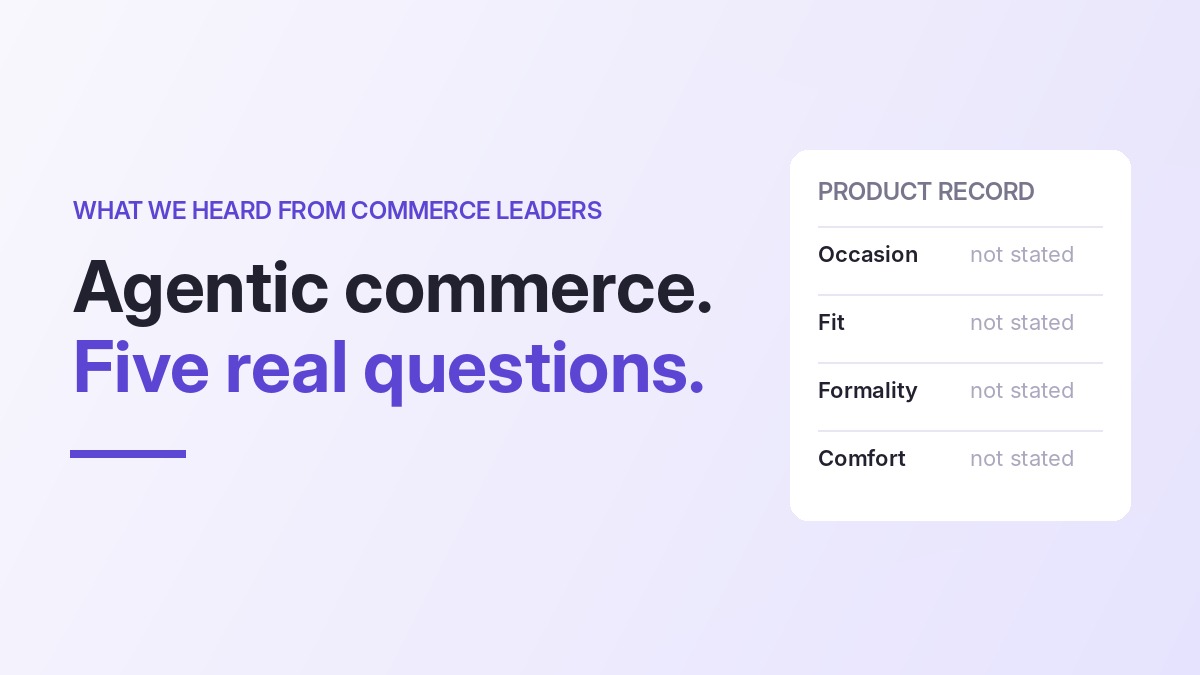
Both are right. But the shift is already happening on their own websites. Shoppers type full sentences into site search, like “a dress for a beach wedding” or “comfortable shoes for standing all day.” If products do not carry attributes for occasion, fit or comfort, those searches return little or nothing. One merchandising leader told us her company provides almost nothing on occasion or formality. That gap costs sales long before the first AI agent arrives.
”Do I have to rebuild my product pages?”
No. Several leaders assumed that richer attributes meant a redesign or months of development work. In practice, better product data can flow into fields a site already has, like titles, descriptions, tags and filters. It can also sit behind the page as structured data that search engines and AI agents read and shoppers never see. The page can look the same while the data behind it does far more work.
”Why not build this ourselves?”
Some teams can. One CTO with a strong data warehouse has built an internal assistant that answers questions about the business. A senior e-commerce director plans to connect a general-purpose AI to his reviews, search and sales data. Another brand’s agency built a tool that fills in basic attributes like fabric and color.
In my view, building the agent is the easy part. The hard part is the data underneath. That means knowing which attributes shoppers in each category actually search for, giving the same answer for the same product every time, and checking every value before it goes live. Without that, a smart agent produces content that drifts away from your source of truth. Build if you have the team. Just budget for the data, not only the agent.
”Is this worth more than my next influencer campaign?”
Smaller brands ask this, and it deserves a straight answer. With a limited budget, a dollar spent on product data competes with a dollar spent on social media. Product data has to earn its place with measurable results, not promises.
Timing matters as much as price. Several teams told us they were interested but in the middle of an ERP migration, a peak season or a leadership change. That is reasonable. Nobody should take on product data in the middle of a system change, or during peak.
What we would tell anyone starting out
Every serious buyer we spoke with wanted a proof of concept before committing, usually two to three months. That is the right instinct. Start with one category, one test and one metric you already trust. Improve the data, measure what changes on your own site, and expand only when the numbers move.
Agentic commerce sounds like a new channel, but it runs on an old asset: accurate, complete product data. No one can promise how an AI model will rank a product. What a brand controls is whether its data gives the model complete, correct details to work with.
That is the work atronous does. We improve the product data brands and retailers already have and add the attributes that shoppers, search and AI agents match on. If you are planning a first test, I would be glad to help you design it. A good place to start is a free C-Score: send up to three product page URLs, and we will show you how they score and what we would add.